
Selected. Trained, Trusted.
A Career Built on Being Chosen for Roles Most Can Only Imagine.
Flight Deck to Flight Deck
There is a particular kind of clarity that only comes at altitude — when the checklist is complete, the weather is building ahead, and every decision is yours to make and yours to own. Dave Williams has spent over 1,400 hours in that clarity, across aircraft that range from aerobatic biplanes to turbine twins to the NASA T-38 jet that astronauts use for spaceflight readiness training..
Flying didn't happen alongside his career. It runs through the centre of it — the same discipline, the same situational awareness, the same commitment to getting the decision right when getting it wrong is not an option.

THE T-38 TALON — NASA'S ASTRONAUT JET
Before a Space Shuttle crew fly to space, they fly the T-38. NASA's supersonic jet trainer. This training keeps astronauts current, sharp, and mission-ready. It is the aircraft that crews use to fly to Kennedy Space Center for launch. Flying the T-38 isn't a perk of the astronaut program. It was part of the discipline the program demanded. From the flight deck of a T-38 to the flight deck of the Space Shuttle, the instruments change but the principles don't.

TWINS & TURBOPROPS - HIGH PERFORMANCE IFR
Whether in a Cessna Turbo 182, a Beechcraft Baron or a King Air Turboprop. Dave has flown high performance aircraft that reward precision and punish complacency. Flying the Baron or the King Air in instrument conditions is as close as general aviation gets to the kind of crew coordination and systems management that define professional operations. It is where aeronautical decision-making stops being theoretical.
AEROBATICS — TRAINED BY A CHAMPION
Most pilots never intentionally point an aircraft at the ground. Dave trained to do it precisely, repeatedly, and to standard — under the instruction of Gord Price, Canadian aerobatic champion. Flying the Pitts S2A and S2B, the Extra 300, and the Zlin 142C, he learned what the envelope actually feels like from the inside — not as a limit to avoid, but as a boundary to understand. That understanding — of what a machine can do when pushed, and what it demands of the person pushing it — translates directly to every high-performance environment he has worked in since.

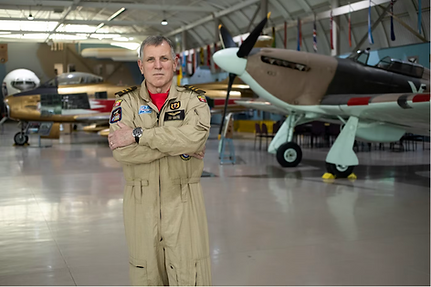
THE WARBIRDS — CANADIAN WARPLANE HERITAGE MUSEUM
Committed to sharing his passion for aviation, Dave is a Board member with the Canadian Warplane Heritage Museum — keeping historic aircraft airborne for the people who come to remember what those machines meant and what the people who flew them gave. Flying warbirds is a different kind of responsibility. Dave has experienced firsthand the excitement of flying the de Havilland Chipmunk and the Fairchild Cornell - primary trainers used by the RCAF in the 1940s.
“Aviation gave me the competency framework that space refined. Crew Resource Management, threat and error management, aeronautical decision-making — these weren't just concepts I encountered in astronaut training. They were things I already understood as a pilot, translated into a new and higher-stakes environment. From the flight deck of a multi-engine twin to the flight deck of the Space Shuttle, the principles don't change. Only the altitude does.”
Dr. Dave Williams
AVIATION CREDENTIALS
Commercial license, Multi-engine & Instrument rated. Type rated on the King Air. Aerobatics experienced. 1,400 hours across single-engine, multi-engine piston, turboprop, jet, historic and aerobatic aircraft. When Dave talks about situational awareness, crew coordination, and decision-making under pressure — he is talking about something he practises every time he goes flying.